Warwickshire Council brings a breath of fresh air to schools with 1,000th air quality sensor
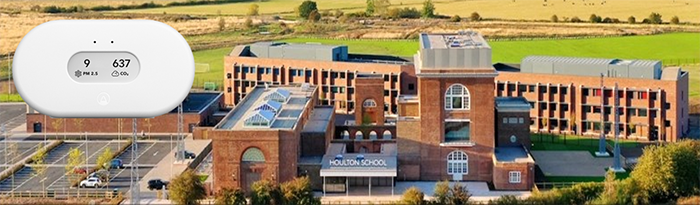
In a milestone achievement, Warwickshire County Council has taken a remarkable step towards creating a healthier environment for students by adding air quality sensors in classrooms in Warwickshire schools.
This initiative showcases the Council’s commitment to providing optimal learning environments for students through the monitoring of indoor air quality in classrooms. Evotech Air Quality has this week installed the 1,000th indoor air quality monitoring sensor in Warwickshire’s schools with more still to come. The data collected from the sensors can be used to support evidence-based policy decisions, identify poorly ventilated areas, and assess the effectiveness of existing mitigation measures.
Studies have shown that exposure to clean air positively affects cognitive development and academic performance and reduces the risk of airborne virus transmission indoors. Our team recently analysed 9.2 million sensor readings and published the findings in a report after completing a 1 year study on CO2 levels in Calderdale schools which highlights poor ventilation. Read the full report here.
READ FULL ARTICLE
|
|
Fewer than one in 10 UK offices
would meet environmental
regulations in 2030
Just 8.3% of UK office space will satisfy new environmental standards set to be enforced from 2030, according to a report from Carter Jonas.
The report also shows that only 11% of floorspace across 12 UK cities built since 2010 would currently meet new minimum energy efficiency standards (MEES) regulations that come into force in seven years’ time. MEES regulations from 1 April made it unlawful to let a property with an EPC rating below ‘E’ and the government intends to raise the minimum to ‘C’ by 2030. The property group assessed office stock in Birmingham, Bristol, Cambridge, Cardiff, Edinburgh, Glasgow, Leeds, Liverpool, London, Manchester, Newcastle and Oxford. The analysis found that only 31.6% of stock is band ’C’ or better, while 17% is in EPC rating bands ‘F’ and ‘G’, 55% is more than 30 years old and almost a quarter was built before 1950.
DOWNLOAD REPORT
|
|
School fined after exposing staff & pupils to high levels of Radon gas
A school in Somerset has been fined £50,000 after exposing two employees, five pupils, and two other children to high levels of the radioactive gas, Radon.
An investigation by the Health and Safety Executive (HSE) found that the school knew they had a radon problem as far back as 2007 when they carried out monitoring and installed some remediation to reduce radon levels. However, from 2010 to 2018 the school carried out no subsequent radon monitoring and had no systems in place to ensure radon control measures were adequate.
The school was fined for breaching Section 2(1) and 3(1) of the Health and Safety at Work etc Act 1974. The Ionising Radiations Regulations 2017 (IRR17) come into force when the annual average activity concentration of radon in the air exceeds 300 Bq/m3.
Since the story broke on July 20 Evotech Air Quality’s team has been engaged by a number of schools wanting to undertake Radon testing. All our #CleanAirSchools have air quality monitors installed as part of our schools air quality initiative that detect Radon and provide both real-time and historic data that can be used to assess the risks from Radon gas.
READ FULL ARTICLE
|
|
Single use vapes spark surge
in blazes as three dumped
every second
Critics are calling on Government to introduce a full-funded kerbside collection system for electrical waste, and a national campaign to educate the public on the correct methods of disposing lithium battery-powered products.
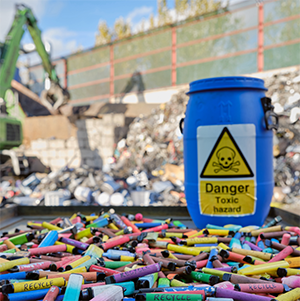
Each week 2 million single use vapes are incorrectly discarded leading to an increase in pollutive waste and increasing the risk of fire in vehicles and homes. Bin lorry blazes have leapt by 62% in the past two years, and house fires have jumped by 108% in the same period. There are around three single use vapes being thrown into general waste bins every second, when regulations stipulate such items need to be placed in recycling and processed with care.
Lithium battery-powered products are becoming a real fire hazard in commercial properties and we advise suitable recycling facilities to be provided for building occupiers.
READ FULL ARTICLE
|
|