|
|
|
|
|
|
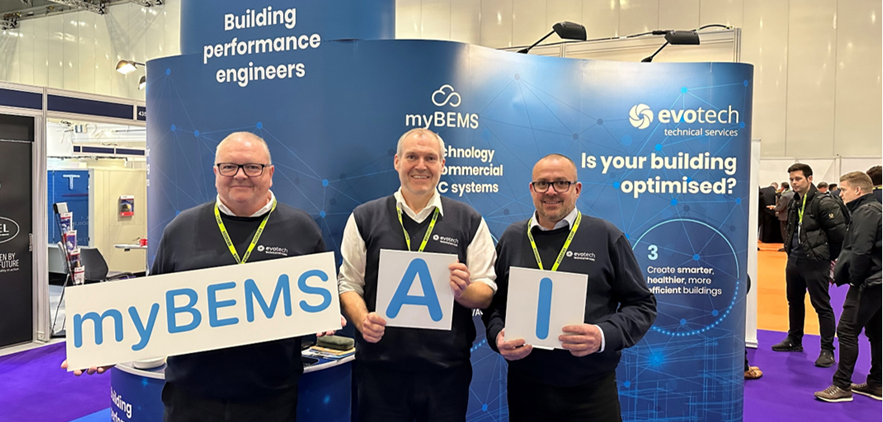
Evotech unveils myBEMS AI at CIBSE Build2Perform 2023
At CIBSE Build2Perform last month, we launched myBEMS AI, a revolutionary range of
machine learning solutions aimed at optimising building HVAC systems, reducing energy
consumption, and slashing carbon emissions.
Building on the success of our myBEMS platform, launched a year ago at Build2Perform 2022,
we have introduced cutting-edge AI solutions to help commercial real estate owners, local
government, and education providers further reduce their energy consumption, helping them
to reach their net zero targets. And, some early adopters have reported considerable monthly
energy savings, demonstrating myBEMS' potential to play a crucial role in helping clients reach
net-zero targets without disrupting their operations.
READ FULL ARTICLE
|
|
|
|
RICS reports rising demand
for green and sustainable
buildings
The Royal Institution of Chartered Surveyors (RICS) global
sustainability report outlines the state of the world’s green and
sustainable real estate and investor interest in acquiring and
developing it.
Occupier demand for sustainable buildings in the UK has risen, and global appetite for green
buildings is on the rise, but legislative uncertainty and lack of measurement is holding industry
back from making a real impact on net zero targets.
In the UK, around three-fifths of contributors suggested that investor demand for green
buildings rose to some extent in the past year. Its headline Sustainable Building Index (SBI)
reported more than 60 percent net balance of respondents believe that demand for green and
sustainable buildings rose over the past year. This UK measure is stronger than the global
average balance, which stands at over 44 percent, although the UK figure lags a little behind
Europe, which records the highest global sentiment at more than 73 percent. Only around 6% of
contributors globally suggest that green features have no impact at all on rents and prices.
READ FULL ARTICLE
|
|
|
|
Ministers misled UK public
when scrapping air quality
regulations
Ministers have been accused of misleading the public after
documents revealed they ignored officials’ advice when
scrapping key air quality regulations, reports the Guardian.
On 31 December, two key air quality regulations dropped off the statute book under the
Retained EU Law (REUL) Act. The rules being revoked are regulations 9 and 10 of the National
Emission Ceiling (NEC) regulations, which set legally binding emission reduction commitments
for five key air pollutants. Officials pointed out that by revoking the regulations with no
replacement, there would ‘no longer be a legal requirement to publish a UK wide document on
emission policies under consideration by all UK administrations’, which they warned would
make ‘tracking or setting our progress towards UK wide emission targets difficult’. They added
there would no longer be clear action after a failure to achieve an emission reduction target.
READ THE FULL ARTICLE
|
|
|
|
New study confirms air
pollution negatively affects
children’s test scores
Researchers at Yale University followed 2.8 million North
Carolina public school students from 2001 to 2018, measuring
their exposure to fine particulate matter (PM2.5).
The study revealed that exposure to PM2.5 concentrations between 10 and 14μg/m3 had a
negative impact on maths scores and levels exceeding just 8μg/m3 was linked to poor reading
performance.
The current legal limit for PM2.5 in the UK is currently set at 20 μg/m3. In 2021, the World Health
Organisation (WHO) updated the limit to 5 μg/m3 as research showed increased risk of
mortality when PM2.5 is below the previous WHO limit of 10μg/m3. This means that now, the
current UK limit is four times more than the updated level recommended by WHO.
Much can be done to ensure children breathe clean air in the classroom, from the use of air
purification units to the installation of MVHR systems that can also recoup spend on energy
and reduce carbon emissions, however, funding is an ever present problem!
DOWNLOAD REPORT
|
|
|
|
85% of organisations have no
fire risk assessment for
Lithium-ion battery devices
Just 15% of organisations say they have conducted a
workplace fire risk assessment to cover the risks posed by
devices containing lithium-ion batteries, new research finds.
The data was gathered from over 500 organisations surveyed during the autumn of 2023, and
whilst 15 percent of respondents confirmed they had updated their fire risk assessments to
cover the risk of LiB fires, 71 percent said they had not and a further 14 percent were unsure.
Assessments should cover Lithium-ion batteries in use, those being charged and being
swapped out, the handling control and containment of damaged batteries, and battery disposal.
Each will require a different strategy and tailored approach to manage associated risks.
READ FULL ARTICLE
|
|
|
|
0333 207 4245 | info@evotech.co.uk | www.evotech.co.uk
Evolution Technical Services Ltd
Northern Office: Lowfields Close, Lowfields Business Park, Elland, HX5 9DX
Southern Office: Grove House, Lutyens Close, Chineham Court, Basingstoke, RG24 8AG
North East Office: 8 Vance Business Park, Norwood Road, Gateshead, NE11 9NE
Humberside Office: Freightliner Road, Hull, HU3 4UW
|